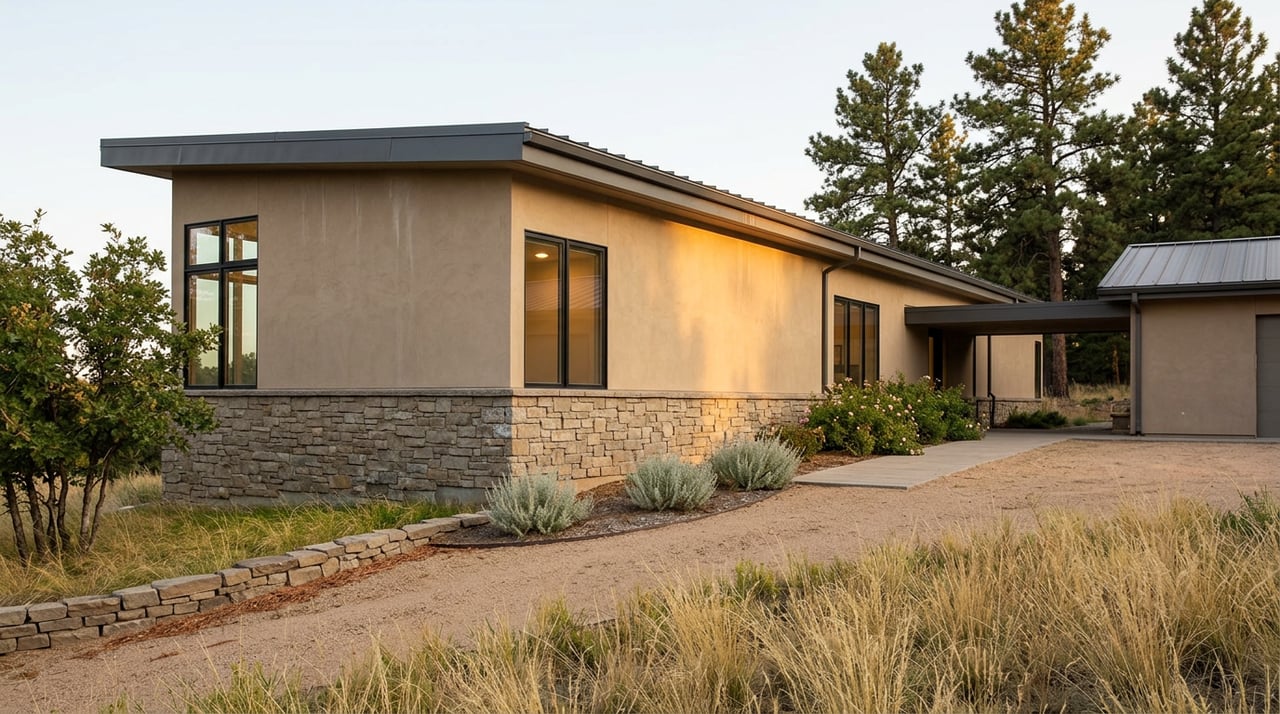
Every listing for acreage in Larkspur, Franktown, Sedalia, or the foothills west of Castle Rock carries some version of the same three words: well and septic. Buyers treat it as one line item, the rural equivalent of confirming a house has central air. It isn't. Depending on which side of Douglas County the property sits on, that line describes two entirely different water systems with two entirely different risk profiles, and the difference matters more to your offer than the square footage of the barn.
On the eastern and central stretch of the county, wells reach down into the stacked bedrock formations of the Denver Basin. On the western edge, in the Pike and Rampart foothills, wells tap fractures in granite rock instead. One system is a finite resource being drawn down faster than it refills. The other refills every year but is unpredictable well to well. Knowing which one sits under a property changes what you should ask for before you remove your inspection objection.
Two Aquifers, Two Very Different Bets
The Denver Basin aquifer system underlies most of eastern Douglas County and supplies both municipal water providers and private wells in communities like Larkspur, Franktown, and The Pinery. Confining rock layers sit between its four stacked formations, the Dawson, Denver, Arapahoe, and Laramie-Fox Hills, which means water doesn't move up from one layer to recharge another. According to Douglas County's own water resources office, the Arapahoe aquifer alone supports more than 1,000 high-capacity wells with estimated annual withdrawals exceeding 168,000 acre-feet, and municipal wells drilled into it can yield up to 700 gallons per minute. That capacity is exactly why it's the workhorse for municipal suppliers across the south metro area. It's also why the water coming out of it took thousands of years to accumulate and isn't being replaced at anywhere close to the rate it's being pumped.
The Pike and Rampart section of the county, roughly a third of Douglas County's land area, runs on a different system entirely. Wells there draw from fractures in granite bedrock rather than sedimentary layers. Precipitation does recharge these aquifers, which makes them renewable in a way the Denver Basin formations are not. But the fractures that carry water are inconsistent, so a well's yield and water quality depend heavily on which fracture network it happens to intersect. Two wells on the same road can produce very different results.
| Denver Basin (east/central county) | Fractured granite (Pike/Rampart, west county) | |
|---|---|---|
| Renewability | Non-renewable, effectively mined | Renewable via precipitation |
| Typical communities | Larkspur, Franktown, The Pinery, Castle Pines Village | Western and southwestern Douglas County |
| Main risk | Long-term water level decline | Inconsistent yield and quality well to well |
| Known local issue | Aquifer-wide declining trend | Perry Park radium contamination (2022) |
What "Declining" Actually Means
The U.S. Geological Survey, working with the Rural Water Authority of Douglas County, has monitored groundwater levels in the county's bedrock aquifers since 2011. Long-term data from that network showed declining water levels across the large majority of monitored wells, with the Arapahoe aquifer, the same formation municipal suppliers lean on hardest, declining faster than the others. County commissioners were briefed on the updated USGS findings in 2025, and the discussion centered on whether to expand the monitoring network rather than whether the decline was real. It was already established.
This is the part that gets lost in a standard walkthrough. A well that produces water fine today isn't the same asset as a well tied to an aquifer with a documented long-term downward trend. If you're buying on the east side of the county and planning to add an accessory structure, expand irrigation, or add household fixtures, ask what the seller's actual pumping history looks like, not just whether the tap currently runs. A flow and yield test at the time of your inspection tells you about today. A declining aquifer tells you something about the next fifteen years.
The Perry Park Question
Perry Park, an unincorporated community west of Larkspur, sits among red rock formations rich in minerals, including radioactive elements. In 2022, the Perry Park Water and Sanitation District notified residents that radium levels in its system tested three to four times higher than normal, with one sample measuring more than twice the EPA limit. Radium exposure over the long term is linked to increased bone cancer risk.
The district's own water system caught this because it tests regularly. A private well in the same geology has no equivalent oversight unless the owner orders it. If you're buying anywhere near Perry Park or in similar rock formations, a standard bacteria test isn't enough. Ask for a full panel that includes radium, uranium, and radon alongside the usual nitrates and hardness readings. This isn't a hypothetical risk invented to sell inspections. It's a documented local event in the exact geology you'd be buying into.
The Permit Decides More Than the Plumbing Does
Here's the part almost no buyer coming from a municipal-water background thinks to check: the well permit itself can restrict what you're legally allowed to do with the water, independent of how good the well performs.
Colorado law splits wells into exempt and non-exempt categories under two different statutes. A residential well on a tract smaller than 35 acres is generally limited to household use only. If your plans include meaningful irrigation, watering horses, or supporting a second dwelling, that use can push the well into non-exempt territory, which triggers a different, more involved permitting process. A well on a tract of 35 acres or more works differently. It can serve household purposes across up to three single-family dwellings and cover limited irrigation and animal watering, but only within specific limits, and if that well diverts more than one acre-foot of water per year even on a 35-acre parcel, it becomes non-exempt too.
None of this shows up during a walkthrough. It shows up when you pull the well permit file through the Colorado Division of Water Resources and compare what the original permit actually authorizes against what you intend to do with the property. A five-acre parcel with a horse barn and a guest cottage might have a well permit that only ever authorized household use inside a single home. That's not a plumbing problem. It's a paperwork problem that surfaces months after closing if nobody checked it first.
What A Standard Inspection Doesn't Cover
Colorado does not require a well inspection or water test as a condition of sale. That responsibility sits entirely with the buyer, which means it has to be something you actively add to your inspection period rather than something you assume is bundled into the general home inspection. The same logic applies to septic. Several Colorado counties adopted mandatory septic transfer-of-title inspections after the state's Regulation 43 took effect in 2013, but requirements vary by county, so confirm directly with Douglas County whether a transfer inspection applies to the specific parcel before you write your offer.
Before you remove objections on a Douglas County acreage property, the checklist should include:
- A flow and yield test on the well, not just confirmation that water comes out of the tap
- A full water quality panel covering bacteria, nitrates, hardness, and, depending on location, radium, uranium, and radon
- A pull of the well's permit history through the Division of Water Resources to confirm what uses the permit actually authorizes
- Confirmation of septic system age, tank location, and whether the county requires a transfer-of-title inspection
- For 35-acre-plus parcels with irrigation or livestock plans, a direct comparison of intended use against the permit's stated allowances
A Few Questions Worth Asking Before You Write the Offer
Does a declining aquifer mean the well will go dry? Not necessarily and not on a predictable timeline. It means the water level is trending downward over time, which affects pumping costs and long-term reliability more than it guarantees a specific failure date. Treat it as a factor in your holding-period math, not a countdown clock.
Is well water in Franktown or Larkspur automatically bad? No. Both communities sit in the Denver Basin system, and quality varies by depth, formation, and individual well construction. The point isn't that the water is unsafe. It's that nobody has tested it for you the way a municipal provider would, so you have to.
Does buying on 35 acres solve the permit problem? It changes the rules, but it doesn't remove them. A 35-acre-plus well can serve more uses, but it's still capped, and exceeding those caps still triggers non-exempt permitting. Bigger acreage buys you flexibility, not an exemption from the math.
Water infrastructure on acreage property is where a good agent's local knowledge earns its keep. If you're evaluating a well and septic property anywhere in Douglas County, from Larkspur to the Pike foothills, the team at Downing Street Group - Engel & Völkers can walk the permit history and inspection stack with you before you're locked into a deadline. Request a private consultation and we'll help you ask the right questions before you write the offer, not after you've already closed.
